Navigation
🏠 Home 🔹 Shadow Health & iHuman 📄 Papers Store 📝 Blog
University Help
🎓 GCU 🎓 Chamberlain 🎓 Walden 🎓 Aspen 🎓 STU
WhatsApp Antony Get Started
NursingProxyResources › Kim Johnson
vSim Case Study

Kim Johnson — T8 Spinal Cord Injury, Rehab Care & SBAR Handoff

Complete Kim Johnson vSim case study covering focused neurologic and sensory-motor assessment, ROM exercises, catheter care teaching, constipation prevention, rehab planning, home-safety modifications, and SBAR handoff for future needs.

vSim CaseSpinal Cord InjurySensory-Motor ExamRehab Planning
View in Papers Store → Ask Antony

🔒 Secure  ·  One-time payment  ·  Instant download

Clinical Overview

Kim Johnson — vSim Spinal Cord Injury Case

Kim Johnson’s vSim case centers on focused neurologic and sensory-motor assessment after a complete T8 thoracic spinal cord injury. That makes the page stronger than generic neuro copy because it combines paraplegia assessment, rehabilitation teaching, bowel and bladder care, and SBAR handoff in one scenario.

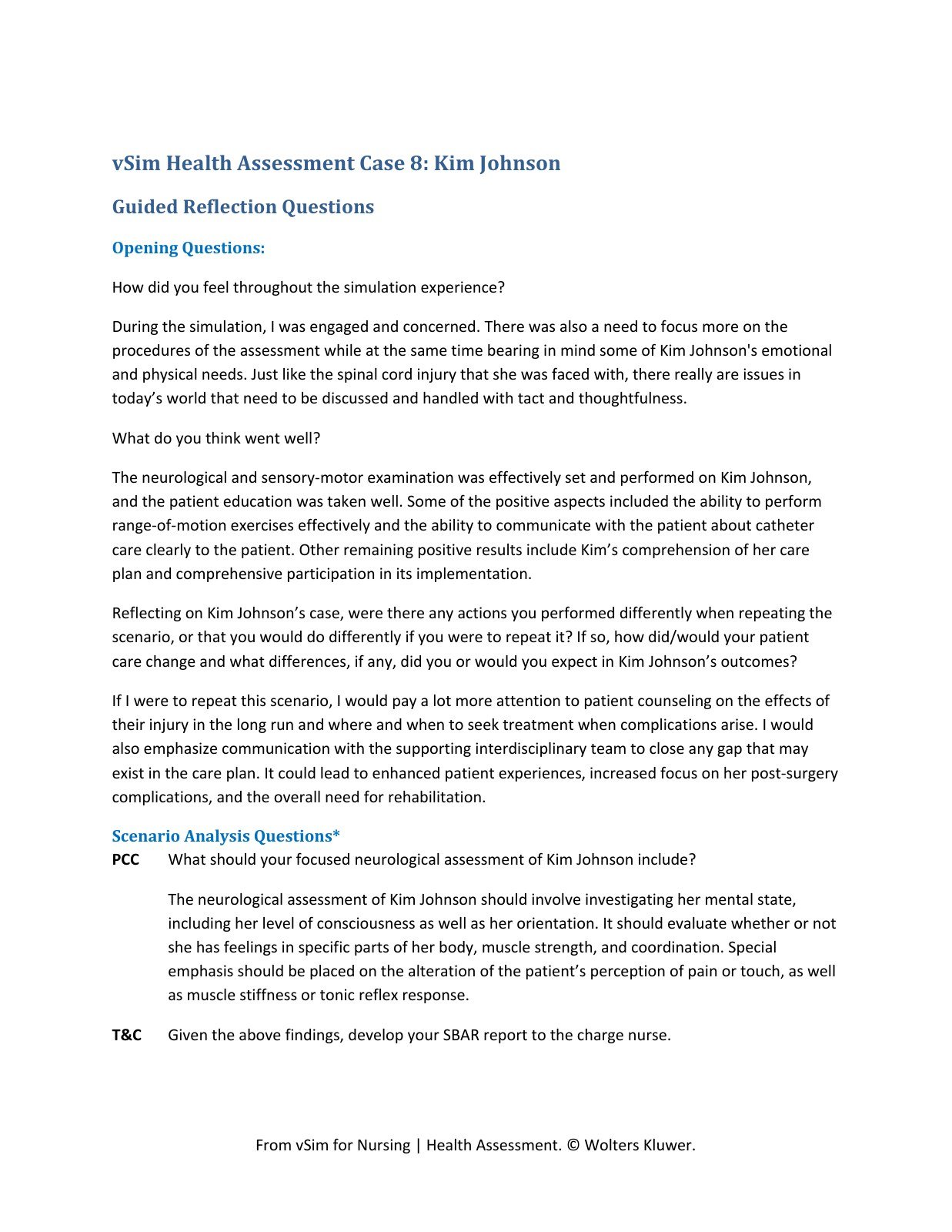
The documentation and guided-reflection files keep the case clinically specific: students are asked to document lower-extremity sensory and motor loss, nursing care and the patient’s response, ROM exercises, catheter-care teaching, constipation prevention, therapy planning, and home modifications that improve safety and accessibility.

The completed bundle reflects the actual Kim Johnson case flow: sensory-motor assessment, ROM support, high-fiber and catheter-care teaching, rehab planning, home-safety preparation, and handoff communication for ongoing needs.

Primary Diagnosis: Focused neurologic and sensory-motor assessment after complete T8 spinal cord injury, with rehab teaching, bowel and bladder care, and SBAR communication of future needs
Included
Sensory-motor findings, nursing-care documentation, ROM and catheter-care teaching, guided reflection, and SBAR handoff details.
Best For
vSim spinal-cord-injury review, rehab teaching, bowel and bladder management support, and handoff preparation.
Available Documents
Choose the exact file you need
If you want everything quickly, start with the full bundle. If you only need one section, swipe through the cards and tap the matching document.
  • Focused neurologic and sensory-motor findings with documentation of absent lower-extremity sensation and movement after complete T8 injury
  • All nursing care provided and Kim Johnson’s response to that care, including ROM work, diet teaching, catheter-care education, and rehab engagement
  • Patient-teaching details covering ROM exercises, high-fiber diet guidance, catheter hygiene and handwashing, aspiration awareness, and complication prevention
  • SBAR handoff content that communicates Kim’s future rehab, bowel and bladder, and monitoring needs to the next nurse
  • Guided-reflection discussion on paraplegia assessment, complications from missing ROM work, and collaboration with PT and OT
  • Home-safety and accessibility content covering wheelchair access, grab bars, furniture spacing, adaptive equipment, and ADA-related resources

Focused neurologic and sensory-motor assessment

Kim’s case is not just a one-time neuro check. It is built around a detailed sensory-motor assessment after complete T8 spinal cord injury, including absent lower-extremity sensation, no purposeful movement, hypotonia, and preserved upper-extremity function.

Rehab planning that adds practical value

The case is useful because it explicitly asks the student to think about ROM exercises, bowel and bladder management, physical and occupational therapy, and home modifications, which makes the page more actionable than a general spinal-cord-injury summary.

Teaching that goes beyond a simple checklist

The documentation assignment highlights catheter hygiene, handwashing, high-fiber diet teaching, aspiration awareness, and complication prevention, which gives the page stronger value for students who need both what to monitor and how to explain it clearly.

Home and long-term planning that gives the page more depth

The scenario also adds discharge-planning value because the student must think through wheelchair access, grab bars, adaptive equipment, and long-term rehab support. That makes the page useful for both assessment and transition-of-care language.

Assessment FocusLower-extremity sensory loss, absent movement, hypotonia, and preserved upper-extremity response are central findings.
ROM FocusActive and passive ROM matter for contracture prevention, flexibility, and long-term function.
Bowel/Bladder FocusCatheter care, constipation prevention, stool softeners, and high-fiber intake are part of the plan.
Home FocusPT/OT coordination, wheelchair access, bathroom changes, and adaptive equipment shape safe discharge planning.
  • Kim Johnson’s case centers on paraplegia after complete T8 spinal cord injury, with teaching and reassessment focused on sensory-motor loss, rehabilitation, and prevention of complications.
  • The documentation asks the student to chart focused neurologic and sensory-motor findings and the patient’s responses, not just list generic nursing tasks.
  • The guided reflection specifically asks what a focused neurologic assessment should include and what complications can occur if ROM exercises are missed.
  • Teaching matters throughout the case because catheter care, high-fiber diet changes, and complication prevention are part of the required documentation and reflection.
  • The SBAR handoff also matters because the next nurse must understand Kim’s bowel, bladder, rehab, and home-planning needs.
  • That combination makes the page useful for students who need both spinal-cord-injury assessment support and patient-teaching language they can actually use.

Objective themes that matter most

The strongest objective anchors in the case are the sensory and motor findings themselves: absent lower-extremity sensation and movement, zero lower-limb strength, hypotonia, and preserved upper-extremity movement and sensation.

Why the objective section still matters

The case is also useful because it ties those findings to immediate rehab decisions: ROM exercises, bladder care, constipation management, therapy referrals, and changes needed to keep the home environment safe and accessible.

SBAR content details

The summary works because it frames Kim as a spinal-cord-injury rehab patient whose care depends on focused assessment, clear documentation, and strong handoff communication as much as on routine observation.

Immediate recommendations

The management value in this case comes from moving beyond symptom recognition toward continued ROM, bladder care, bowel monitoring, rehab coordination, and communicating clearly what should happen next as Kim transitions toward discharge planning.

What the reflection answers add

The guided reflection adds academic value because it explicitly addresses priority neurologic and sensory-motor needs, ROM-related complications, and which interprofessional team members should be involved.

Why the post-case section still matters

The education details add practical depth too: explaining the injury to the patient, reinforcing hand hygiene and diet changes, discussing home accessibility, and making sure the next care step is clear before handoff.

FAQ

Common questions about Kim Johnson vSim results

The page combines sensory-motor assessment, paraplegia findings after complete T8 injury, ROM care, catheter teaching, constipation prevention, rehab planning, home modifications, and SBAR handoff support. That gives it much more depth than routine neuro copy.

The spinal-cord-injury context matters most because Kim has no sensation or purposeful movement in the lower extremities, which changes what the nurse must assess, teach, and plan for during rehabilitation and discharge preparation.

The case emphasizes continued ROM exercises, close bowel and bladder care, catheter hygiene, constipation prevention, PT and OT coordination, home adaptation planning, and a clear SBAR handoff for what needs monitoring next.

The teaching points focus on passive ROM exercises, high-fiber diet changes, catheter care and handwashing, pressure and complication prevention, therapy planning, and the home changes that may be needed for wheelchair access and daily living.

Yes. The updated content is based on the attached Kim Johnson vSim documentation and guided-reflection files, including spinal-cord-injury assessment, rehab teaching, bowel and bladder management, home-safety planning, and SBAR-handoff themes.